


Monday, February 13, 2023

Study Iaido in Ann Arbor

Are you interested in broadening your martial arts study to include Japanese sword arts? 
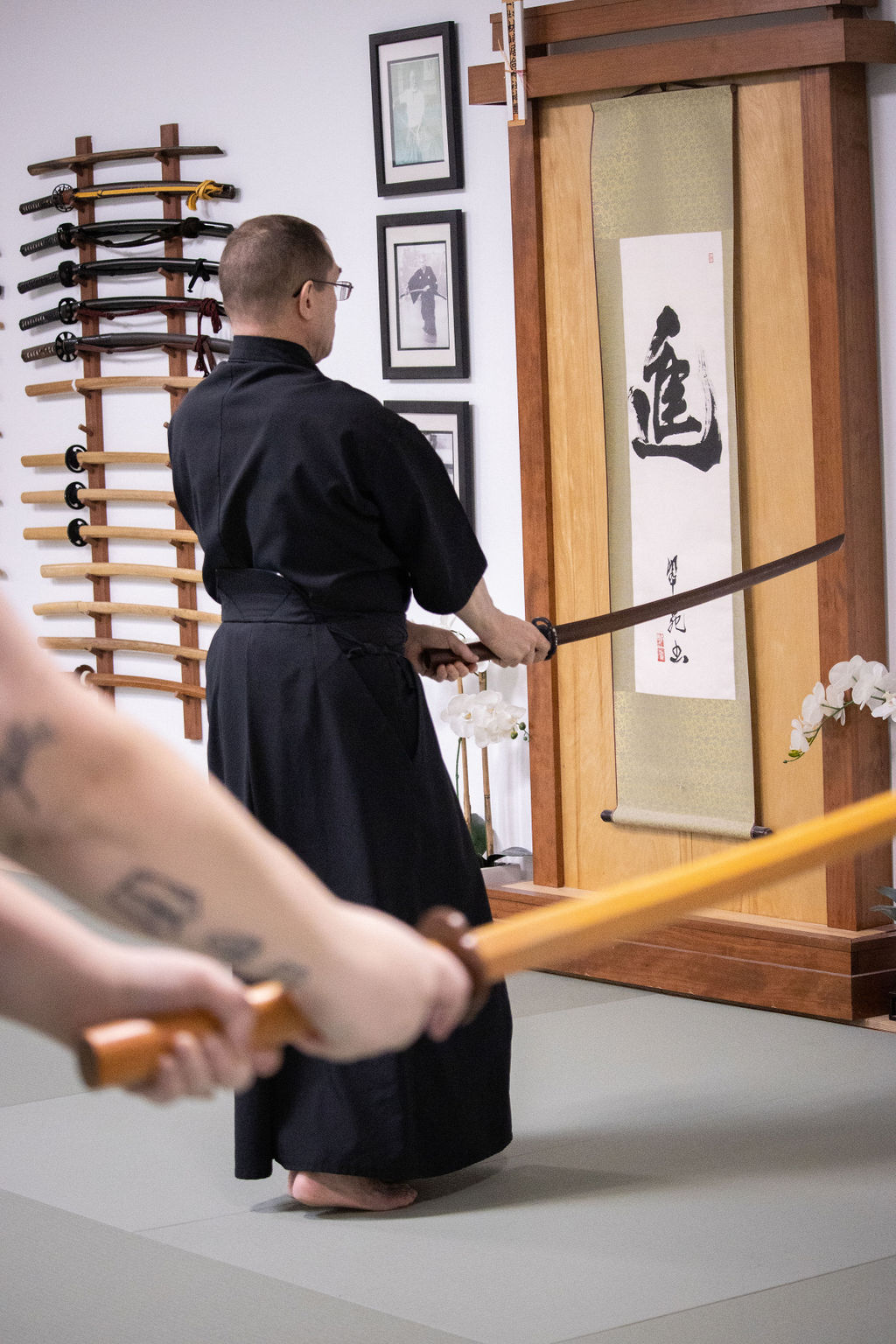
Martial artists holding bokkens while practicing iaido in Ann Arbor

At Japanese Martial Arts Center, we practice and teach the art of iaido, led by Nicklaus Suino Sensei, four-time All-Tokyo Champion.

When you learn iaido in Ann Arbor, you’ll learn more than how to handle a katana. You’ll immerse yourself in a personal journey to hone your concentration, perception, and presence. 

At JMAC, we embrace a culture of respect for each other and for the Japanese martial arts. We’re committed to supporting the personal growth of all who train here. We thrive together.

Visit our website to learn about our classes, including the Japanese sword art of iaido.

Learn Iaido in Ann Arbor

Visit JMAC and experience our commitment for yourself. Contact us here on the website or call 734-720-0330 to arrange a free introductory lesson or to watch a class.

Wednesday, February 1, 2023

Japanese Sword Fighting Arts

Do you feel drawn to the grace and power of Japanese swordsmanship?

A man holding a bokken while practicing iaido in Ann Arbor

Japanese swordsmanship is an ancient art and discipline heralding back to the samurai of feudal Japan. It still encompasses the reverence the samurai felt for the sword. Over the years, the art of swordsmanship grew into many different styles and schools. 

The art of the sword is often referred to collectively as kenjutsu, but you’ll also see kenjutsu taught as a type of swordsmanship. You’ll find that different schools or dojos teach different types of swordsmanship. Some popular types include:

  • Iaido
  • Iaijutsu 
  • Kenjutsu 
  • Kendo 

Learn more about Japanese swordsmanship at JMAC!

Learn Iaido in Ann Arbor

At Japanese Martial Arts Center, we practice and teach the art of iaido, led by Nicklaus Suino Sensei, four-time All-Tokyo Champion.

When you learn iaido in Ann Arbor, you’ll learn more than how to handle a katana. You’ll immerse yourself in a personal journey to hone your concentration, perception, and presence. 

Visit JMAC and experience our commitment for yourself. Contact us here on the website or call 734-720-0330 to arrange a free introductory lesson or to watch a class.

Monday, January 16, 2023

What Weapons Can You Use in Gendai Budo?

Wondering why there are so few weapons in martial arts dojos?

The majority of weapons used in martial arts were used in “old style” martial arts, called koryu bujutsu. These martial arts were meant to be used in battles to protect the entire group rather than one’s self. The martial arts we know today – karate, judo, jujutsu, etc. - are considered gendai budo. These are modern martial arts meant for self-defense and self-improvement rather than for battle.

Here are some weapons you may see in modern martial arts:

A person holding a katana for iaido in Ann Arbor

Katana – The katana is a sword with a long, curved, single-edged blade and is meant to be held with two hands. In iaido, you’ll practice first with a wooden sword called a bokken, then with an alloy sword called an iaito. Advanced students can practice with a shinken – sharp edged sword – like a katana. Katanas were meant to cut down enemies in one smooth movement.

Yumi – A yumi is a longbow used in the art of Kyudo – Japanese archery. The bows are much larger than the kind used in Western archery, and the arrows - called "ya" - are made from bamboo. Bushi warriors also used bows in early battles, but later, during the Edo period, kyudo began being studied as a modern martial art to aid in physical and spiritual development.

See more Japanese weapons!

Work with Weapons When You Practice Iaido in Ann Arbor

Working with weapons is fun!

You can practice martial arts with weapons by studying iaido at JMAC.

Did you know iaido can be done by anyone? It doesn’t matter your age, experience, or skill!

To start practicing iaido in Ann Arbor, contact JMAC today!

Monday, January 2, 2023

What Type of Weapons did the Bushi Use?

 Are you interested in ancient combat weapons?

The bushi – occupational warriors in feudal Japan - used many weapons while fighting. The majority of weapons used in martial arts were used in “old style” martial arts, called koryu bujutsu. These martial arts were meant to be used in battles to protect the entire group rather than the lone warrior.

Here are a few examples:

Person using naginata | Iaido Ann Arbor

Naginata – The naginata is a long, slightly curved blade mounted on a long pole. They were used to stab and strike on the battlefield. The koryu bujutsu martial arts style that utilized naginatas is called naginatajutsu.

Yari – The yari is a long spear that has different types of blades. The most common blade was flat and sharp on both sides like a dagger. Yaris were used for cutting and stabbing and practiced in sojutsu.

Tanto – The tanto is a dagger with a long blade and short handle used for slashing and stabbing. The bushi used them in tantojutsu.

Learn about modern martial arts that use weapons!

Work with Weapons When You Practice Iaido in Ann Arbor

Working with weapons is fun!

You can practice martial arts with weapons by studying iaido at JMAC.

Did you know iaido can be done by almost anyone? Adults of any age, experience, or skill are welcome in our programs!

To start practicing iaido in Ann Arbor, contact JMAC today!

Wednesday, December 14, 2022

Grappling Arts from Around the World

Grappling is a concept in combat sports that consist of grabbing and manipulating the opponent. Grappling moves include takedowns, throws, holds, and sweeps, but no striking moves like punching and kicking. Grappling works well for up-close combat and self-defense.

Take a look at grappling arts from China and Korea!

Shuai Chiao Shuai Chiao, sometimes spelled Shuai Jiao, is the most ancient Chinese martial art. It was first used by the Chinese military in 2697 B.C. and used to feature more violent moves, like striking, joint locks, and even bone breaking and joint dislocation. Now Shuai Chiao focuses more on grappling. The goal is to throw opponent to ground while you’re still standing, or to fall with them, but end up on top of them.

Grappling arts - Judo Ann Arbor

Ssireum Ssireum is a Korean grappling sport that takes place in a sand pit. You and your opponent’s hands are linked by belts at each other’s waists and thighs. The goal is to throw the opponent off balance and have any part of their body above the knee touch the ground. Ssireum began in the fourth century and is now a national sport in Korea. 

Learn about Sambo, a fighting system from Russia on our website!

Study Judo in Ann Arbor

Does grappling sound fun to you?

It certainly can be! Judo free practice, called randori, is considered to be “play” by many judo students because it’s so much fun!

Are you nervous about long term contracts?

You can sign up for a 2-month trial membership at JMAC to make sure judo is right for you!

 To start practicing judo in Ann Arbor, contact JMAC today!

Thursday, December 1, 2022

A Brief History of Grappling Arts

Do you want to increase your strength?

Fighting systems that use grappling may be right for you!

a man being thrown to the ground during judo in Ann Arbor

Here are two common martial arts that use grappling:

Judo – Judo is a Japanese martial art based on the principle that a smaller person can take on a larger, stronger opponent with the right skills. Judo was formed by Jigoro Kano in 1882 and uses throws, takedowns, chokes, and joint locks. Most throws require grabbing the opponent’s gi. To win a judo match, you can perform an ippon - throwing the opponent down on their back - make the opponent submit, or score the most points by performing throws, locks, and holds.

Brazilian Jiu Jitsu (BJJ) – Brazilian Jiu Jitsu is the Brazilian form of Japanese jujutsu created by Carlos Gracie in 1920s. Unlike Judo, BJJ takes place mostly on the ground using takedowns, chokes, and joint locks. The goal in BJJ is to get your opponent to the ground and have them submit.

Learn more about grappling arts!

Study Judo in Ann Arbor

Does grappling sound fun to you?

It certainly can be! Judo free practice, called randori, is considered to be “play” by many judo students because it’s so much fun!

Are you nervous about long term contracts?

You can sign up for a 2-month trial membership at JMAC to make sure judo is right for you!

 To start practicing judo in Ann Arbor, contact JMAC today!

Monday, November 14, 2022

Beginner Falls

Want to learn how to fall safely?

Follow these instructions for beginner falls!

Two-Hand Back Fall: This fall utilizes all the basics. From a sitting position, keep your arms outstretched and keep your legs straight and together. Then, lean back while lifting your legs into the air, and as soon as your back hits the mat, slap with both hands and come back down to the sitting position.

With these same principles, you can do one-handed back falls and side to side falls.

Standing Back Fall: When you fall standing up, you don’t want to fall straight like a tree. You could land on your head or fall with more force than necessary. You want to try to sit as much as possible during the fall so you don’t fall as far. To practice, stand with your arms straight in front of you. Bend your knees as if you’re trying to sit on your heels and fall backward. Once your back hits the mat, slap.

Standing back fall | Martial Arts Ann Arbor
Learn how to do forward rolls on our website!

Safe, Systematic Instruction! Martial Arts in Ann Arbor

We're not a fighting dojo, we're a learning dojo! When you train at JMAC, you can have peace of mind that it’s a safe environment where we listen to you and assess your skills before putting you in more challenging activities.

Receiving an injury is unlikely, but never impossible. That’s why we train safely and systematically. We can proudly say we’ve never had a serious injury! 

To start practicing martial arts in Ann Arbor, contact us today!


Tuesday, November 1, 2022

Ukemi Basics

Are you a beginner? Considering martial arts training?

Suino Sensei slapping the mat | Martial Arts Ann Arbor

You’ll learn the basics first, which include stances, punches, and falling correctly.

The art of falling in martial arts is called ukemi and there are many types of falls.

The Basics:

When falling, it’s important to prevent a head injury. To prevent injury, keep your chin tucked to your chest and focus on something in front of you, like your belt knot. If your eyes are unfocused, you might rock your head during the fall. As soon as your back hits the mat, slap the mat with your arms from shoulder to fingertip. Keep your arms positioned in a “v” shape when you do this rather than holding your arms out straight like a plus sign. When your arms are straight, your head tends to go back. Keep your legs uniform as one unit.

Learn about basic beginner falls on our website!

Safe, Systematic Instruction! Martial Arts in Ann Arbor

We're not a fighting dojo, we're a learning dojo! When you train at JMAC, you can have peace of mind that it’s a safe environment where we listen to you and assess your skills before putting you in more challenging activities.

Receiving an injury is unlikely, but never impossible. That’s why we train safely and systematically. We can proudly say we’ve never had a serious injury! 

To start practicing martial arts in Ann Arbor, contact us today!

Friday, October 14, 2022

The Colors of Gi

Have you ever wondered why some opponents in martial arts wear blue or white Gi? 

Two martial artists in Ann Arbor

Do you think the color of a martial artist's Judogi coordinates with their skill level? 

The reason for having two colors in a competition is so simple yet controversial.

Why the Blue? 

Originally, the judogi was white to symbolize purity. Before the introduction of the blue Gi in 1986, a competitor would wear a red sash on their belt to distinguish the two competitors. Only having a red sash on the uniform made it hard for the judges, referees, and the audience to tell apart the two opponents apart. To help tell the two opponents apart, the blue Gi was born. Despite the color difference, blue is only intended to distinguish between competitors. 

The Conspiracy 

Despite the blue Gi only being used for contrast, people believed there was more to it than that. During the 2004 Olympics, the opponents who wore blue Gi appeared to outperform those in white, leading people to believe blue gis had some sort of advantage. Members of the community also argued the Gi should remain “pure” and only the traditional white should be an authorized uniform.

Because of this controversy, several studies were done to see if color had a psychological effect on the competition. To this day there’s no evidence showing a correlation between color and performance.

Learn more about the history of the gi on our website!

Learn Martial Arts in Ann Arbor 

Are you interested in learning more about martial arts? With JMAC classes, you will feel a sense of community in the dojo. All you have to do is show up!

Contact us today to begin your journey with martial arts in Ann Arbor. 

Saturday, October 1, 2022

Understanding Where the Gi started

Do you ever wonder why you’re required to wear certain attire in martial arts?

Knowing the history allows you to have a deeper connection and understanding of the martial arts you practice. 

The Conception of the Judogi
A martial artist in Ann Arbor holding another judoka's gi

Origin - The Gi was invented by Jigoro Kano Sensei. While Kano was practicing judo, he realized the traditional Japanese kimono was not suitable for practice. After realizing this, he made alterations, such as making the material thicker to allow better anchorage while fighting as well as loosening the fit for better grappling.

Evolution - As time progressed, changes continued to be made to the Gi. Originally only produced in white, the International Judo Federation (IJF) allowed the Gi to be made in blue as well so judges, referees, and the audience could better differentiate the competitors. In addition to color, long sleeves became the “traditional cut” the Gi is now known for.

Standardization - After the design was altered, rules and regulations were set in place. The IJF set rules and guidelines on material specifications, manufacturing, and sizing of the Judogi. To ensure conformity to the rules, a red label is required on the Gi to show compliance. 

Learn more about the Gi on our website!

Learning Martial Arts in Ann Arbor 

If you think martial arts might be for you, come down to our dojo and feel a sense of community. No matter where you’re at in your fitness journey, we’ll make it work! Contact us today to begin your journey with martial arts in Ann Arbor.

Wednesday, September 14, 2022

Martial Arts Can Keep Older People Fit

Do you want to improve your fitness?

Martial arts training can help older people stay in shape. Older people can sometimes settle into a sedentary lifestyle. A body in rest tends to stay in rest, while a body in motion tends to stay in motion! Martial arts training can help keep you moving and improve your balance, flexibility, and reflexes. You don’t have to choose a physically demanding style like jujutsu to get these health benefits! Slow, precise styles like iaido can keep you moving and help you gain more control of your body while being easier on the cardiovascular system.

woman kicking during martial arts in Ann Arbor

Learn more about how martial arts in Ann Arbor can benefit older people.

Martial Arts in Ann Arbor Has No Age Limit!

You’re never too old to try something new!

At JMAC, we’ll figure out your current fitness level and help you learn while gradually improving your fitness. You’ll be trained in a safe systematic way to prevent injuries and never have to do anything you don’t feel ready for.

If you’re interested in martial arts in Ann Arbor, we’d love to have you come watch a class. Call us at (734)645-6441 or fill out our contact form to schedule a visit! 

Thursday, September 1, 2022

Why Older People Should Study Martial Arts

When you think of martial arts, you may imagine a dojo full of men in their 20s-30s. This isn’t the case! There are plenty of women and older people who study martial arts. Preconceived notions like this might inhibit older people from beginning martial arts training. 

A man punching during martial arts in Ann Arbor

Here are some reasons you should start!

Good for mental health – Exercise creates endorphins that can boost your mood and relieve stress. Learning new moves and skills can help keep your brain sharp and raise your self-esteem!

Good for personal development – You may have built your life, career, and family, but that doesn’t mean you’re done! You can always create new goals and build yourself up. Martial arts can help you become more mindful, focused, and a better version of yourself!

Learn more reasons you should start learning martial arts in Ann Arbor!

Martial Arts in Ann Arbor Has No Age Limit!

You’re never too old to try something new!

At JMAC, we’ll figure out your current fitness level and help you learn while gradually improving your fitness. You’ll be trained in a safe systematic way to prevent injuries and never have to do anything you don’t feel ready for.

If you’re interested in martial arts in Ann Arbor, we’d love to have you come watch a class. Call us at (734)645-6441 or fill out our contact form to schedule a visit! 

Monday, August 15, 2022

How to be a Great Training Partner

Two people practicing judo | Martial Arts Ann Arbor
A dojo is more than a training room. It’s a commitment by everyone who trains there to create a safe, respectful space. Training with a partner is a great way to achieve that – at JMAC, we thrive together. 

When training with a partner, remember to be respectful. There are many ways to show respect in the dojo. Practice good personal hygiene and always wear a clean uniform. Be present and pay attention to your partner, their needs, and your sensei. How we present ourselves reflects our respect for our instructor, classmates, dojo, and culture.  

Learn more about being a great training partner through martial arts in Ann Arbor!

Positive, Supportive Martial Arts in Ann Arbor

Visit JMAC and experience our supportive environment for yourself. Contact us or call 734-720-0330 to watch a class or to take a free introductory lesson. Then, if you’d like to join us in focused, supportive martial arts in Ann Arbor, we’ll start you down a path of positive change that will impact your life and mindset in ways you never expected!

Monday, August 1, 2022

How to Create a Supportive Dojo

Your dojo is more than a place to get a great workout. It’s a safe, respectful place to learn and thrive together – a place where character is developed and strengthened. But that doesn’t come from the uniform or the mat. It comes from the people, and everyone at the dojo plays a part. 

Two people practicing judo | Martial arts Ann Arbor

Whether you are young or not so young, new to martial arts or an instructor, you can be a positive and supportive force in your dojo. 

One way you can make a positive impact is when you’re training with a partner. Being the best training partner not only helps your partner, but is an important stage in your own development. 

Learn more about being a great training partner through martial arts in Ann Arbor!

Positive, Supportive Martial Arts in Ann Arbor

Visit JMAC and experience our supportive environment for yourself. Contact us or call 734-720-0330 to watch a class or to take a free introductory lesson. Then, if you’d like to join us in focused, supportive martial arts in Ann Arbor, we’ll start you down a path of positive change that will impact your life and mindset in ways you never expected!

Thursday, July 14, 2022

Increase Your Focus with Martial Arts

Do you have an attention disorder?

Martial artists smiling | Martial arts Ann Arbor

Would you like to improve your focus and find an uplifting community?

Here are some ways martial arts can help:

Improving Focus – Martial arts techniques are taught in small chunks over a long period, so you can focus on mastering one technique before moving on to the next. The moves are intricate, requiring concentration and patience to perfect.

Reaching Goals – Unlike team sports, practicing martial arts is an individual journey. All you have to focus on is your performance and growth. It also helps when you have something to work towards! The colored belts act as goals and rewards for your work.

Creating Community – People with ADHD may feel left out. At JMAC, we’re a community who can lift you up! Your success means the success of the entire dojo, so we’ll do everything we can to help you succeed and feel included.

Read more ways martial arts can help on our website!

Begin Martial Arts in Ann Arbor

Don’t know which martial art is right for you?

Watch a class with no obligation! At JMAC, we practice karate, judo, Nihon jujutsu, and iaido. See our schedule to watch a class. If you like what you see, you can schedule two free intro lessons!

To start studying martial arts in Ann Arbor, contact JMAC today!

Friday, July 1, 2022

How can Martial Arts Help with Attention Disorders?

Do you want to improve your focus, control, and concentration?

Two people practicing martial arts in Ann Arbor

Would more structured activities help your attention disorder?

Martial arts may be able to help! While many resources for ADHD and other attention disorders may be targeted towards children, martial arts can help adults and children alike!

Here are some ways martial arts can help you:

Increasing Activity – Exercise not only helps express hyperactive energy, but boosts motivation, lowers impulsiveness, and improves memory.

Creating a Routine – The dojo is a structured environment where you repeat key activities. Every class starts with a bow, warm ups and basics. After learning and practicing the day’s techniques, we bow to end class. This structure can be comforting to someone who may have a hard time setting routines and organizing themselves.

See other ways martial arts can help those with attention disorders!

Begin Martial Arts in Ann Arbor

Don’t know which martial art is right for you?

Watch a class with no obligation! At JMAC, we practice karate, judo, Nihon jujutsu, and iaido. See our schedule to watch a class. If you like what you see, you can schedule two free intro lessons!

To start studying martial arts in Ann Arbor, contact JMAC today!

Monday, June 13, 2022

What are Internal Martial Arts?

a person practicing iaido, a martial art in Ann Arbor
Internal martial arts focus more on breathing, ki/chi (Japanese and Chinese terms for energy), flow, and relaxation. Examples include Tai chi, Bagua, Hsing-i, Kyudo, and Iaido. One important goal of internal martial artists is to find relaxation and mental strength. After you make progress with those, you can enter more physically demanding situations. The work you do internally will contribute to the external result, such as in the case of Kyudo and Iaido, a more precise shot or fluid strike.

See how to categorize martial arts.

Study Martial Arts in Ann Arbor

When you study martial arts in Ann Arbor at JMAC, there are multiple styles to learn! We offer iaido, nihon jujutsu, judo, and karate programs.

Not sure which art is right for you? 

You can watch a class with no obligation! See our schedule. If you’re happy with what you see, you can schedule two free intro lessons to make sure your choice is a good fit.

Contact us today to begin practicing martial arts in Ann Arbor!

Wednesday, June 1, 2022

How to Categorize Martial Arts

Have you noticed some martial arts are physical and powerful, while others seem peaceful and introspective?

How can these differences between martial arts be categorized?

One way is to distinguish between internal and external, or hard and soft styles. The distinction between internal and external comes from how the arts are learned, while the distinction from hard and soft comes from the fighting approach.

Two martial artists in Ann Arbor practicing judo

External Martial Arts

External martial arts include judo, karate, Muay Thai, and Hungar kung fu. These arts are typically more concerned with developing athletic skill sets - movements that rely on muscular strength, cardiovascular fitness, and explosive power. When learning external martial arts, you’ll likely improve your physical fitness first, and after reaching your physical limit, focus on internal elements that can improve your physical performance, like breathing and relaxation. External martial arts often have you learn movements first, then their meaning/purpose. Think of it this way: you’re learning the art from the outside (your body) to the inside (your spirit).

Learn more about internal, soft, and hard martial arts.

Study Martial Arts in Ann Arbor

When you study martial arts in Ann Arbor at JMAC, there are multiple styles to learn! We offer iaido, nihon jujutsu, judo, and karate programs.

Not sure which art is right for you? 

You can watch a class with no obligation! See our schedule. If you’re happy with what you see, you can schedule two free intro lessons to make sure your choice is a good fit.

Contact us today to begin practicing martial arts in Ann Arbor!

Friday, May 13, 2022

Learn the Features of an Iaito

Looking for an iaito?

Want to learn the individual parts of the sword?

Here are features you’ll want to examine and definitions you should know:

Sword composition – Along the blade, a bohi (groove) is ideal to create the whooshing sound when the blade is aligned correctly. Some blades have a double bohi, but a single, deep bohi is better. The hamon (temper line), is only decorative on alloy iaito – it doesn’t contribute to performance, so the style is a matter of your personal preference. 

Hand Guard – A smooth, round, heavy tsuba (hand guard) is recommended. A heavy tsuba helps bring the weight of the sword closer to your hands. With a lighter tsuba, the kissaki (sword tip) will be heavier, causing the sword to be harder to control. Try to get a tsuba free of corners or textures because they’re hard on the hands.

Scabbard – Make sure your saya (scabbard) has a wooden opening rather than a metal one. A metal saya will scratch your sword and shorten its life.  

Learn more about iaito swords.

Study Iaido in Ann Arbor

Anyone can practice iaido! It may seem intimidating, but at JMAC, we adapt to the pace of our students. You’ll learn how to handle a sword at your own pace in a safe, supportive environment.

Contact us today to begin practicing iaido in Ann Arbor!


Sunday, May 1, 2022

What Makes a Great Practice Sword?

Are you interested in practicing iaido in Ann Arbor?

A little lost when it comes to swords?

We practice Muso Jikiden Eishin Ryu iaido at JMAC, and there are many factors that make for a good practice sword -called an iaito- for this style:

Sword Material – Consider an alloy blade, as they tend to have a better feel than steel, which has good feel only in very expensive iaito.

Sword Length – Japanese swords are typically measured in the ancient system of shaku, sun, bu - roughly equal to a foot, an inch, and a centimeter. A typical iaito for our practice is between 2-shaku 3-sun (27.4 inches) and 2-shaku 4-sun 5-bu (29.2 inches). To find the best blade length for you, hold your right arm out straight and to the side, parallel to the floor. The length of your blade should be about the distance from the center of your sternum to the center of your right palm. 

Learn what other factors make a great sword!

Study Iaido in Ann Arbor

Anyone can practice iaido! It may seem intimidating, but at JMAC, we adapt to the pace of our students. You’ll learn how to handle a sword at your own pace in a safe, supportive environment.

Contact us today to begin practicing iaido in Ann Arbor!